—— From AI-powered information retrieval to intelligent decision-making, how can brands build new competitive advantages?
Official Account Summary: AI is evolving from a Q&A tool to one for information retrieval, brand comparison, and business decision-making. The technological landscape of platforms, both domestic and international, is changing the way brands are discovered and recommended. What kind of brand assets do companies need to build? And how can they continuously validate the effectiveness of their optimization through GEO?
In the first half of this year, a consensus emerged in the industry: If agents are to do their jobs, they must first be able to look up information – whoever provides them with information will be the gateway to the next generation.
At that time, this was still theoretical. Now, the opening up of search capabilities, AI shopping, and Agent applications are gradually bringing this assessment into product practice.
Over the past two years, the focus of competition among AI platforms has been on "who can provide the better answer." Now, the competition is entering the next phase.
The two paths, overseas and domestic, seem different, but ultimately point to the same change:AI is no longer just answering questions, but is now involved in users' information gathering, brand comparison, option selection, and purchasing decisions.
This also means that GEO can no longer be simply understood as "making brands appear in ChatGPT." It is becoming the information infrastructure for brands in the Agent era.
01 Restructuring Search Capabilities: From Standalone Portals to Agent Infrastructure
One noteworthy change is that the competition for AI capabilities is breaking through the boundaries of single applications. Search is no longer just a standalone product used directly by users; it is also gradually becoming a foundational service that can be called upon by various applications.
TencentThe Yuanbao Search MCP allows third-party agents to call the search service after completing the corresponding access configuration. It supports real-time search, specified URLs, time ranges, and other capabilities. Specific vertical search capabilities are subject to the service version.
DeepSeek:The Search and Fetch interfaces are used for web search and web content retrieval, respectively, providing retrieval capabilities for agents that require external information.
Alibaba Cloud and Volcano Engine:Products such as Bailian and Doubao also offer various forms of online search capabilities. Depending on the application scenario, developers can integrate search capabilities into office software, intelligent customer service, enterprise knowledge assistants, and industry agents.
At the same time, overseas platforms are also expanding AI's capabilities in information access and commercial services.
ChatGPT: Product Discovery and Shopping Research
ChatGPT is expanding from conversational Q&A to product discovery and shopping research, helping users filter and compare products based on their budget, preferences, and specific needs. Paid ads and organic product recommendations operate under different mechanisms.
Google: Combining search with personal context
When users actively grant permission and meet the conditions for feature access, AI can leverage personal information from Gmail, Photos, and other sources to provide recommendations that are more closely aligned with individual needs.
TikTok: Integration of content and shopping services
Explore the connections between content, shopping assistance, and lead qualification through capabilities such as Buy Direct, Shopping Assistant, and Agentic Leads. The pace of rollout varies by region.
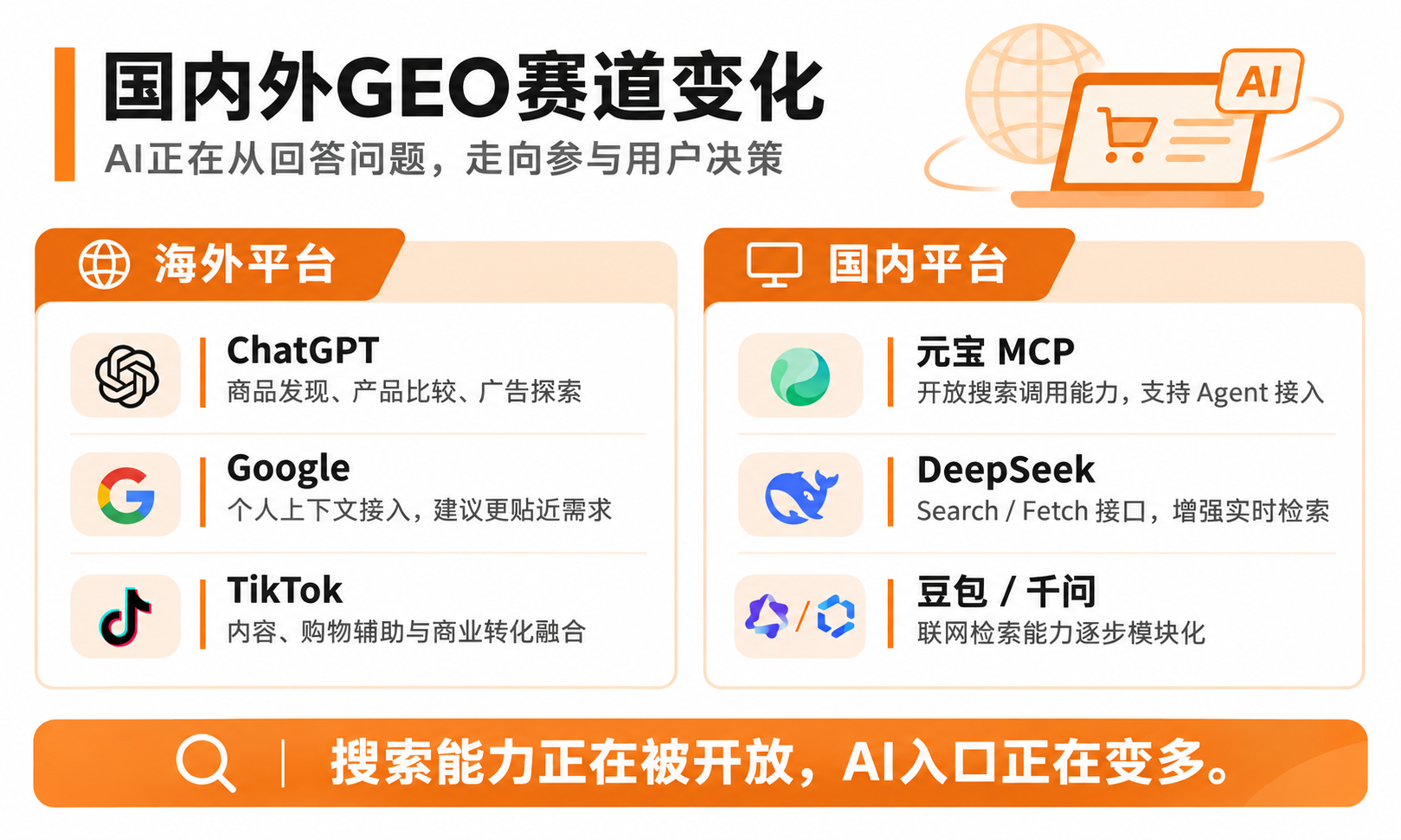
Figure description: Overseas platforms are continuously expanding product discovery, personalized search, and shopping services, while domestic platforms are gradually opening up search invocation capabilities. The entry points for AI to obtain information are becoming more diverse.
These changes indicate that AI is becoming involved in more aspects of how users obtain information and make choices. The target audience for brand information is no longer limited to users who actively search, but also includes various intelligent applications that can invoke search services.
02 Changes in recommendation logic: from information exposure to brand value judgment
As platform capabilities evolve, the evaluation dimensions that brands need to focus on also expand.
In the past, companies focused more on search rankings, content exposure, and page clicks. Now, they also need to monitor how their brands appear in AI responses, their recommended positions, product descriptions, and cited sources.
A brand being mentioned by AI does not equate to the brand receiving a recommendation; likewise, a brand receiving a recommendation does not necessarily mean that AI has accurately understood the brand.
For example, an intelligent home company can be properly introduced when users ask about the brand name, but when users further ask, "What whole-home intelligent systems are suitable for large homes?" the brand is not included in the list of recommendations. This indicates that although the brand has a certain level of basic recognition, in specific application scenarios, the AI may still lack sufficient information to determine the match between the product and the user's needs.
Another example is an industrial equipment company that holds numerous technical certifications and has several practical application cases. However, its official website only lists product names and basic specifications, failing to clearly present the products corresponding to the certifications, their application scenarios, and their technical advantages. Even if the company itself is strong, AI may not be able to accurately extract this information.
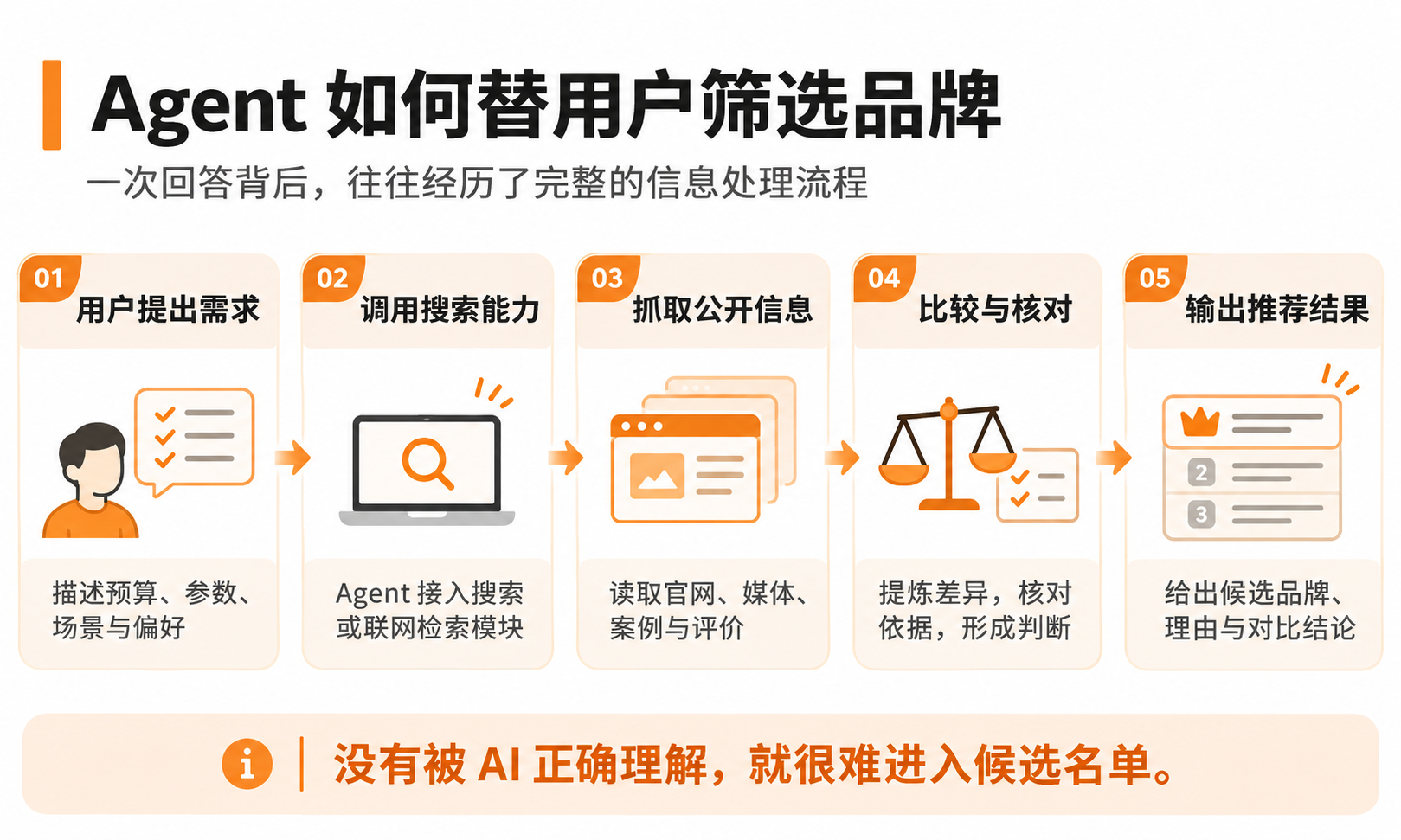
Diagram description: An AI recommendation may involve stages such as understanding the request, retrieving information, accessing publicly available data, comparing differences, and generating results. The completeness of brand information affects the AI's understanding of the brand.
Therefore, GEO cannot be limited to article publication and keyword coverage. Companies also need to stay informed about: What information has already been acquired by AI? Which advantages have not been accurately understood? For which questions is the brand absent? What external sources does AI primarily reference?
GEO is shifting from simply adding content to systematically managing a brand's visibility and perceived performance in AI.
03 Escalation of Brand Competition: Building an Information System That AI Can Recognize and Verify
For companies that already have a certain content foundation, the next most worthwhile investment is not simply increasing the number of articles, but rather re-evaluating the four brand capabilities.
01|Information readability: Make corporate information accurate and complete
The brand description, product specifications, features, prices, scope of services, and delivery terms on the official website, product pages, and Help Center should all be accurate and consistent. Structured markup, such as Schema and JSON-LD, can be used to clarify the relationships between brands, products, and businesses, improving the organization of information and making it easier for machines to understand. Structured markup alone does not guarantee AI indexing or recommendations.
02|Scenario matching: Aligning product advantages with real needs
Users don't just want to know what products a company offers; they want to know if those products can solve their problems. Companies need to explain for whom the product is suitable, what budget it fits, in what usage environment it works, and why it is suitable. During the diagnostic phase, Douzhi can select 15–30 core questions that are highly relevant to the business. It then tests the brand's performance on mainstream AI platforms using different question formulations and, based on the results, plans the content direction accordingly.
03|Credibility of the source: Providing external validation for brand strengths
Industry media, professional reviews, customer case studies, content from vertical platforms, and genuine user reviews can all serve as important supplements to brand information. Douzhi categorizes source development into three levels: official information, vertical media, and authoritative media, allowing core brand facts to be externally corroborated through different channels.
04|Recommendations and Conversions: Enabling Continuous Validation of Optimization Results
After a brand is recommended, users may further search for brand terms, visit the official website, and check reviews and case studies before deciding whether to inquire or make a purchase. Therefore, companies need to comprehensively evaluate the optimization effect by combining data such as AI mentions and recommendation performance, brand term searches, official website visits, and inquiries.
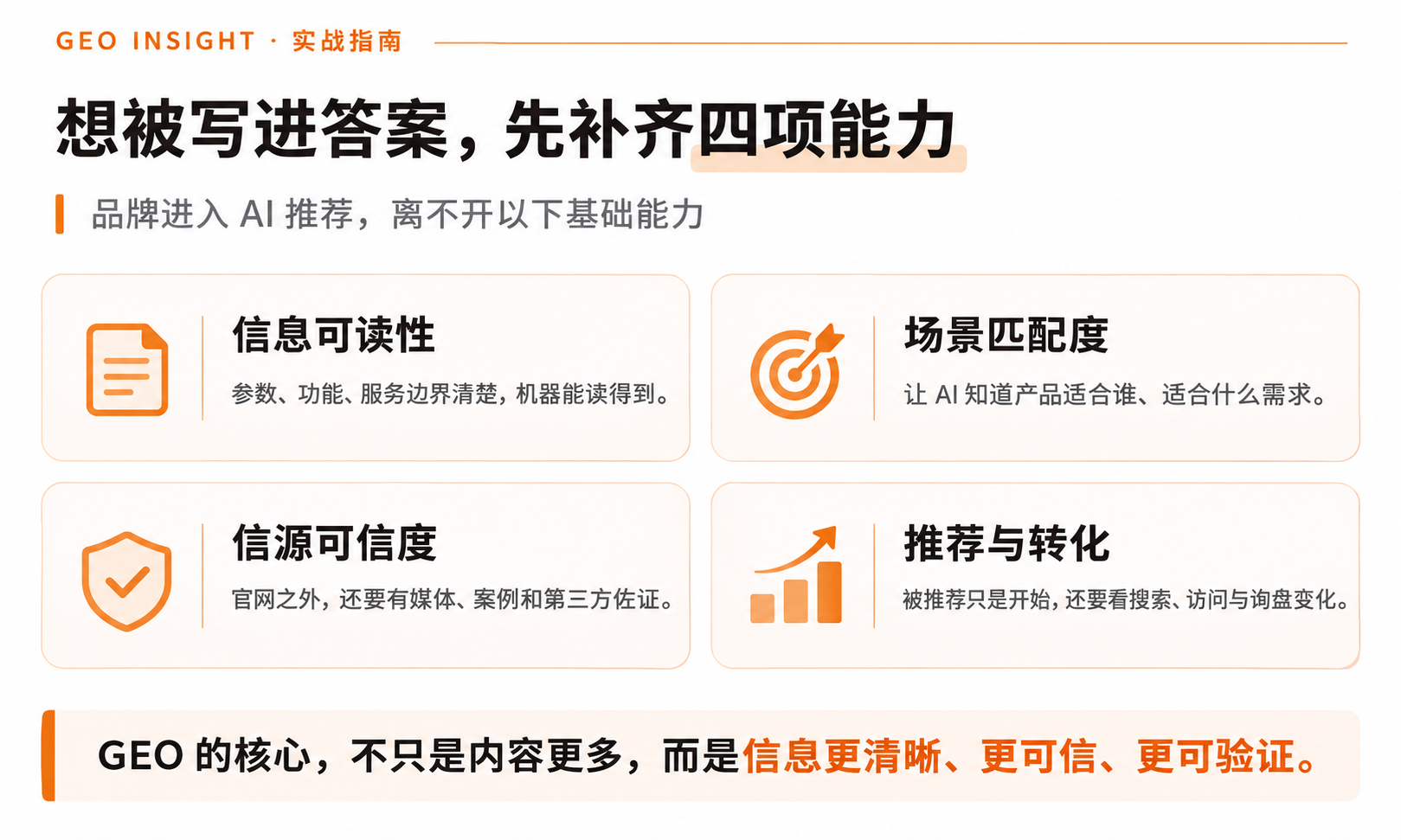
Figure Description: The four capabilities correspond to information acquisition, understanding of needs, external evidence, and evaluation of effectiveness, respectively, and together form the foundation for brand participation in AI recommendations.
These four capabilities do not mean that all companies need to invest a large amount of resources all at once. However, it is even more important for companies to develop these capabilities in advance if their customers need to make repeated comparisons before making a purchase, if their products are highly specialized, if there are many competitors in the industry, or if they rely heavily on the trust of third parties.
04 Brand Self-Assessment: Where Does Your Company Stand in the AI World?
After a brand has completed its basic content development, it still needs to answer a more practical question: How can we tell whether GEO is actually effective? A single AI response can only reflect performance at a specific time and for a specific question, and it cannot represent the overall AI visibility of the brand.
Why not open a mainstream AI assistant and ask five questions about the brand:
01 Brand Introduction:What does the XX brand do? What are its core products and advantages?
02 Competitor Comparison:What are the advantages and disadvantages of the XX brand compared to its main competitors?
03 Product Information:What product models, specifications, and service information does the XX brand currently offer?
04 Category Recommendations:If you need to purchase XX products, which brands or manufacturers are worth considering?
05 Cross-Platform Comparison:Switch to another AI platform, repeat the above questions, and compare whether the answers from different platforms are consistent.
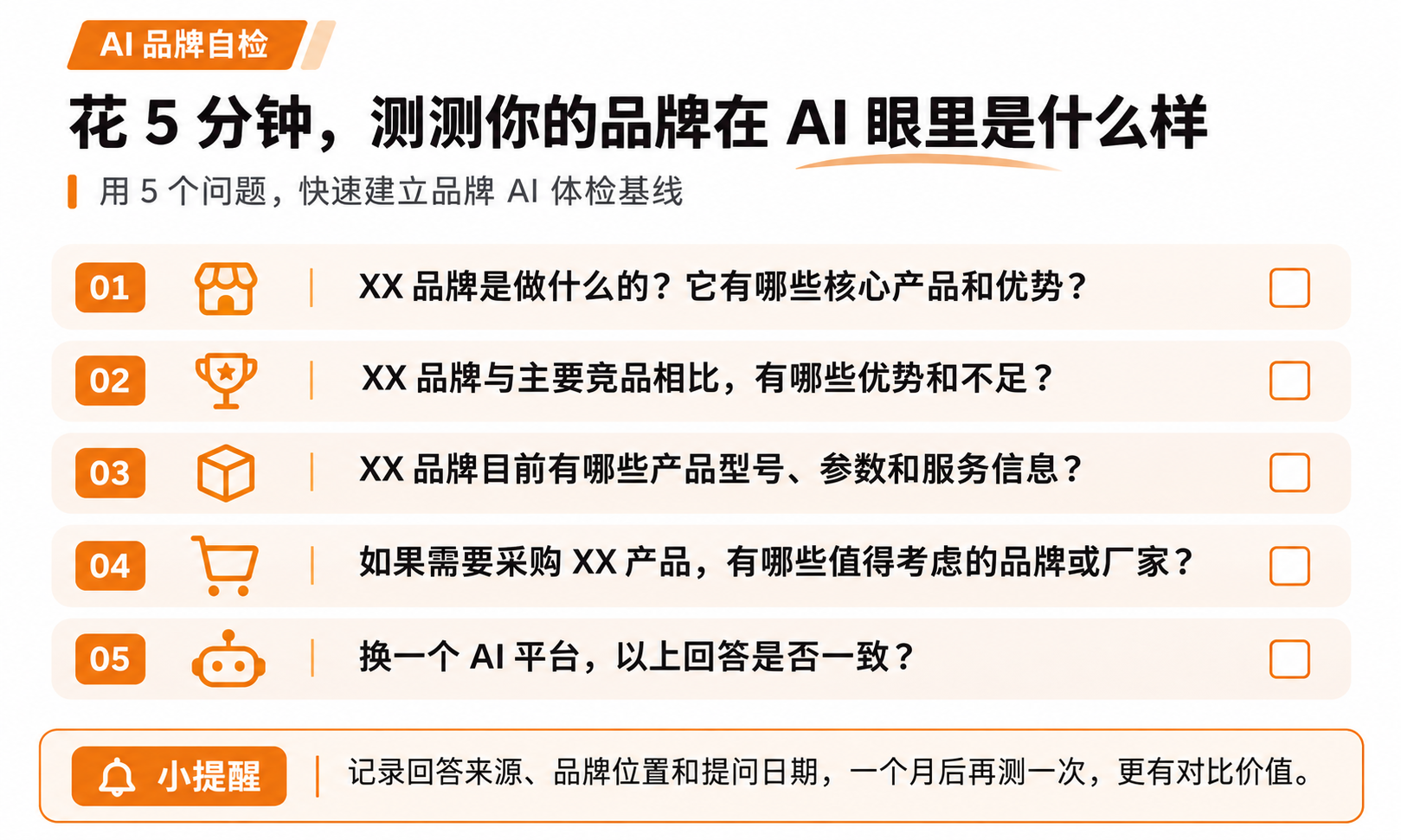
Figure description: Record the source of the answer, the location of the brand's appearance, and the date of the question, and try to keep the question consistent with the platform. Conduct the test again after one month to form a meaningful before-and-after comparison.
In addition to the brand mention rate, attention should also be paid to the Top 1, Top 3, average ranking, citation sources, sentiment, and perception accuracy, as well as the differences in performance between the PC and app versions.
When combined, these data points can help companies move beyond simply determining whether AI has mentioned them to further assessing their brand performance, identifying issues, and determining the next steps for optimization.
05 Re-establishing brand competitive advantage in the age of agents
As GEO shifts from one-off content placements to long-term management, companies need not only a content execution team but also a system that can continuously collect, analyze, and track performance.
This was also the original intention behind Douzhi Semantic's development of the DZOS-AI intelligent monitoring system. DZOS establishes a workflow system that covers everything from issue monitoring to performance review, focusing on AI-driven brand monitoring, GEO optimization, and AI visibility management.
Task Center | Continuous tracking of core issues
Establish tasks around brands, issues, competitors, platforms, and monitoring frequency, and continuously collect responses from different AI platforms.
GEO Insights | Analyzing Differences Between Brands and Competitors
Observe brand performance and changes in competing products through indicators such as mention rate, Top 1, Top 3, and average ranking to identify issues that need to be prioritized for optimization.
Link Monitoring | Track AI Citations
Record the links to the cited web pages, the source platforms, and the corresponding answers to understand which external information the AI primarily references.
Sentiment Overview | Monitor Changes in Brand Awareness
Continuously analyze positive, neutral, and negative information in AI responses, focusing on brand reputation, product feedback, and potential cognitive biases.
Reporting Center | Comparison of performance before and after optimization
Compare brand performance across different time periods through weekly reports, monthly reports, and periodic reviews, and analyze changes in conjunction with the original collection records.
At the same time, DZOS supports separate monitoring on the PC and app ends, preserving the original text of the actual collected responses, screenshots, and cited information. Currently, the system is compatible with 14 AI platforms and related terminals, including DeepSeek, Doubao, Tencent Yuanbao, Ernie Bot, Tongyi Qianwen, Kimi, ChatGPT, and Gemini.
We aim to help companies establish not a one-time brand exposure, but a GEO management system that can continuously identify issues, adjust and optimize strategies, and validate actual performance.
END Enable brands to build long-term competitiveness in the AI era
Although AI platforms in China and abroad are developing in different directions, they are all driving changes in how users access information. The opening up of search capabilities, AI shopping, personal context access, and the development of agent applications are forging a closer connection between AI and users' actual needs.
For businesses, GEO should not be limited to the number of articles published or the number of keywords covered. What really matters is: Is the brand information accurate? Are the product advantages clear? Are external sources of information sufficient? Can AI understand it correctly? Can the optimization results be continuously verified?
A brand's AI visibility is not simply built up through an accumulation of content, but rather through accurate information, genuine evidence, and continuous optimization.
If your brand is implementing AI search and you want to understand its current real-world performance across different AI platforms, you can start with a free diagnostic. Doz will select 15–30 core questions related to the company's business to test how the brand is mentioned, recommended, and cited on mainstream AI platforms. This will establish a quantitative baseline and determine the direction for subsequent optimization based on actual performance.
The partnership adopts a monthly evaluation mechanism, complemented by a first-month no-obligation refund policy for those who meet the agreed-upon conditions. Understand the delivery and evaluation criteria before deciding on a long-term partnership.
Douzhi Semantic · DZOS-AI
Make brands seen, trusted, and chosen in the AI era.
AI Brand Monitoring | GEO Optimization | AI Visibility Management
When users ask AI "Which one is good?", brands have a basis for being understood, validated, and recommended.
Douzhi Semantic
Official Website:www.aigcllm.com
Contact Email: Ryan@aigcgeo.com